


Konsentrasi
Dalam ilmu kimia, konsentrasi atau kepekatan adalah ukuran yang menggambarkan banyaknya zat di dalam suatu campuran yang dibagi dengan "volume total" dari campuran tersebut. Ada empat macam deskripsi kuantitatif konsentrasi, yaitu:
konsentrasi massa, konsentrasi molar, konsentrasi jumlah, dan konsentrasi volume.[1] Istilah konsentrasi dapat diterapkan untuk semua jenis campuran, tetapi paling sering digunakan untuk menggambarkan jumlah zat yang terlarut di dalam larutan. Konsentrasi molar mempunyai variasi seperti konsentrasi normal dan konsentrasi osmotik.
Deskripsi kualitatif[sunting | sunting sumber]

Sering kali dalam situasi informal, bahasa non-teknis, konsentrasi dideskripsikan secara kualitatif, meskipun penggunaan kata sifat seperti "encer" untuk larutan dengan konsentrasi relatif rendah dan "pekat" untuk konsentrasi yang relatif tinggi. Untuk memekatkan suatu larutan, harus dilakukan salah satu, yaitu menambahkan zat terlarut lebih banyak (misalnya, alkohol), atau mengurangi jumlah pelarut (misalnya, air). Sebaliknya, untuk mengencerkan suatu larutan, harus dilakukan salah satu, yaitu menambah pelarut atau mengurangi jumlah zat terlarut. Terdapat suatu konsentrasi di mana tidak ada zat terlarut yang larut lagi dalam larutan, kecuali kedua zat tersebut sempurna bercampur. Pada titik ini, larutan dikatakan jenuh. Jika zat terlarut ditambahkan ke dalam larutan jenuh, ia tidak akan larut, kecuali dalam kondisi tertentu, yaitu kondisi supersaturasi. Dalam kondisi ini pemisahan fasa tidak terjadi, tetapi yang terjadi adalah pencampuran fasa, baik terpisah sempurna atau bercampur sebagai suspensi. Titik jenuh bergantung pada banyak variabel seperti temperatur ambien dan natur kimia yang pasti dari pelarut dan zat terlarut.
Notasi kuantitatif[sunting | sunting sumber]
Ada empat kuantitas yang menjelaskan konsentrasi:
Konsentrasi massa[sunting | sunting sumber]
Konsentrasi massa didefinisikan sebagai massa suatu konstituen dibagi dengan volume campuran :


Satuan internasional: kg/m3.
Konsentrasi molar[sunting | sunting sumber]
Konsentrasi molar didefinisikan sebagai jumlah konstituen dibagi dengan volume campuran :


Satuan internasional: mol/m3. Meskipun demikian, satuan yang lebih umum digunakan adalah mol/L (= mol/dm3).
Konsentrasi hitung[sunting | sunting sumber]
Konsentrasi hitung didefinisikan sebagai jumlah entitas konstituen dalam campuran dibagi dengan volume campuran :


Satuan internasional: 1/m3.
Konsentrasi volume[sunting | sunting sumber]
Konsentrasi volume (jangan bingung dengan volume fraksi) didefinisikan[1] sebagai volume konsetituen dibagi dengan volume campuran :


Satuan internasional: m3/m3.
Kuantitas terkait[sunting | sunting sumber]
Beberapa kuantitas lain dapat digunakan untuk menjelaskan komposisi campuran. Perlu dicatat bahwa ini tidak bisa disebut konsentrasi.[1]
Normalitas[sunting | sunting sumber]
Normalitas (kenormalan) didefinisikan sebagai konsentrasi molar dibagi dengan faktor ekivalensi . Karena definisi faktor ekivalensi bergantung pada konteks (bergantung pada reaksi yang diteliti), IUPAC dan NIST jarang menggunakan normalitas.

Molalitas[sunting | sunting sumber]
(Jangan bingung dengan Molaritas)
Molalitas larutan didefinisikan sebagai jumlah konstituen (dalam mol) dibagi dengan massa pelarut (bukan massa larutan):


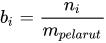
Satuan internasional: mol/kg.
Fraksi mol[sunting | sunting sumber]
Fraksi mol didefinisikan sebagai jumlah konstituen (dalam mol) dibagi dengan jumlah total konstituen dalam campuran (dalam mol):


Satuan internasional: mol/mol. Namun, kadang bagian-per notasi sering digunakan untuk menjelaskan fraksi mol kecil.
Rasio mol[sunting | sunting sumber]
Rasio mol didefinisikan sebagai jumlah konstituen dibagi dengan jumlah total konstituen lainnya dalam campuran:

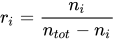
Jika lebih kecil daripada , rasio mol hampir sama dengan fraksi mol.
Satuan internasional: mol/mol. Namun, kadang bagian-per notasi sering digunakan untuk menjelaskan rasio mol kecil.
Fraksi massa[sunting | sunting sumber]
Fraksi masa adalah fraksi salah satu zat dengan massa dibagi dengan massa total campuran :


Satuan internasional: kg/kg. Namun, kadang bagian-per notasi sering digunakan untuk menjelaskan fraksi massa kecil.
Rasio massa[sunting | sunting sumber]
Rasio massa didefinisikan sebagai massa konstituen dibagi dengan massa total seluruh konstituen lainnya dalam campuran:

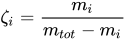
Jika jauh lebih kecil daripada , rasio massa hampir sama dengan fraksi massa.
Satuan internasional: kg/kg. Namun, kadang bagian-per notasi sering digunakan untuk menjelaskan rasio massa kecil.
Pemekatan[sunting | sunting sumber]
Pemekatan adalah suatu proses untuk menaikkan suatu kadar zat tertentu yang ingin dipekatkan. Contoh paling gampang ada pada industri sirup, ekstrak buah (encer) yang terbentuk harus dipekatkan terlebih dulu untuk mencapai skala ekonomis tertentu sebelum layak dijual. Proses ini umumnya memakai medium panas untuk mengurangi kadar air yang ada sehingga kandungan ekstrak buah yang ada akan meningkat.
Kebergantungan kepada volume[sunting | sunting sumber]
Konsentrasi bergantung pada variasi volume larutan terutama karena ekspansi termalnya.
Tabel konsentrasi dan kuantitas terkait[sunting | sunting sumber]
| Jenis konsentrasi | Simbol | Definisi | Satuan SI | satuan lain |
|---|---|---|---|---|
| konsentrasi massa | atau | kg/m3 | g/100mL (=g/dL) | |
| konsentrasi molar | mol/m3 | M (=mol/L) | ||
| konsentrasi hitung | 1/m3 | 1/cm3 | ||
| konsentrasi volume | m3/m3 | |||
| Kuantitas terkait | Simbol | Definisi | Satuan SI | satuan lain |
| normalitas | mol/m3 | N (=mol/L) | ||
| molalitas | mol/kg | |||
| fraksi mol | mol/mol | ppm, ppb, ppt | ||
| rasio mol | mol/mol | ppm, ppb, ppt | ||
| fraksi massa | kg/kg | ppm, ppb, ppt | ||
| rasio massa | kg/kg | ppm, ppb, ppt |


Lihat pula[sunting | sunting sumber]
Referensi[sunting | sunting sumber]
- ^ a b c IUPAC, Compendium of Chemical Terminology, 2nd ed. (the "Gold Book") (1997). Online corrected version: (2006–) "concentration".